Latest news, Oct 26, 2026: Please enjoy the latest BumpySkies newsletter, reflecting on the past year of working on this project.
QTR778, MIA to DOH, departing 8:25 PM EDT, Oct 26
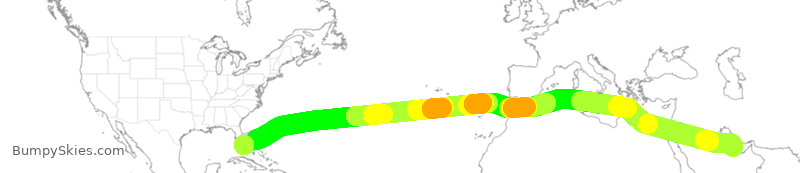
(Forecast data last collected at 1:00 AM EDT on Oct 27, 2026.)
- Takeoff from MIA at 8:25 PM EDT, Oct 26.
- 8:26 PM EDT: Light turbulence likely for the next 20 minutes.
- 8:46 PM EDT: Moderate turbulence likely for the next 21 minutes.
- 9:07 PM EDT: Light turbulence likely for the next 1 hour and 47 minutes.
- 10:54 PM EDT: Moderate turbulence likely for the next 2 minutes.
- 10:56 PM EDT: Light turbulence likely for the next 2 minutes.
- 10:58 PM EDT: Moderate turbulence likely for the next 3 minutes.
- 11:01 PM EDT: Light turbulence likely for the next 20 minutes.
- 11:21 PM EDT: Moderate turbulence likely for the next 28 minutes.
- 11:49 PM EDT: Light turbulence likely for the next 3 minutes.
- 11:52 PM EDT: Moderate turbulence likely for the next 2 minutes.
- 11:54 PM EDT: Light turbulence likely for the next 1 minute.
- 11:55 PM EDT: Moderate turbulence likely for the next 6 minutes.
- 12:01 AM EDT: Light turbulence likely for the next 2 minutes.
- 12:03 AM EDT: Moderate turbulence likely for the next 1 minute.
- 12:04 AM EDT: Light turbulence likely for the next 4 minutes.
- 12:08 AM EDT: Moderate turbulence likely for the next 15 minutes.
- 12:23 AM EDT: Light turbulence likely for the next 2 minutes.
- 12:25 AM EDT: Moderate turbulence likely for the next 47 minutes.
- 1:12 AM EDT: Light turbulence likely for the next 8 minutes.
- 1:20 AM EDT: Calm skies for the next 36 minutes.
- 1:56 AM EDT: Light turbulence likely for the next 5 minutes.
- 2:01 AM EDT: Calm skies for the next 14 minutes.
- 2:15 AM EDT: Light turbulence likely for the next 4 minutes.
- 2:19 AM EDT: Calm skies for the next 17 minutes.
- 2:36 AM EDT: Light turbulence likely for the next 1 hour and 32 minutes.
- 4:08 AM EDT: Calm skies for the next 22 minutes.
- 4:30 AM EDT: Light turbulence likely for the next 2 minutes.
- 4:32 AM EDT: Calm skies for the next 33 minutes.
- 5:05 AM EDT: Light turbulence likely for the next 22 minutes.
- 5:27 AM EDT: Moderate turbulence likely for the next 2 minutes.
- 5:29 AM EDT: Light turbulence likely for the next 1 hour and 3 minutes.
- 6:32 AM EDT: Calm skies for the next 24 minutes.
- 6:56 AM EDT: Light turbulence likely for the next 53 minutes.
- 7:49 AM EDT: Calm skies for the next 14 minutes.
- 8:03 AM EDT: Light turbulence likely until you land.
- Landing at DOH at 8:57 AM EDT.

Nelly says: Bumpy skies can be scary, but they're not dangerous!
See our turbulence safety page for more information, including links to other resources for nervous fliers.
BumpySkies needs your support
If BumpySkies helped you today, consider leaving a tip, or get additional features with a monthly subscription.
Support BumpySkies with a $5 monthly subscription and receive premium features, including cloud-cover forecasts and turbulence-forecast notifications sent straight to your phone or email.
Tips of any size received with gratitude. If you tip at least $5 you can envision Nelly buying an airport coffee with it. If you tip at least $10 I'll tell her gently that maybe she should make it a decaf.

Forecast window-seat views with First Class
BumpySkies First Class includes cloudiness forecasts, letting you see which parts of your flight will likely involve passing through or over clouds, and how often you'll instead have clear views of the ground below. Like our turbulence forecasts, they can help you manage your expectations of what you'll see and experience during your flight.
Already a First Class Subscriber? Log in.
Nelly says: Clouds are sometimes spooky, but they're always safe!
Flying through clouds is routine and safe, even when it feels disorienting to nervous passengers. Learn more about it on our flight safety page.
BumpySkies needs your support
If BumpySkies helped you today, consider leaving a tip, or get additional features with a monthly subscription.
Support BumpySkies with a $5 monthly subscription and receive premium features, including cloud-cover forecasts and turbulence-forecast notifications sent straight to your phone or email.
Tips of any size received with gratitude. If you tip at least $5 you can envision Nelly buying an airport coffee with it. If you tip at least $10 I'll tell her gently that maybe she should make it a decaf.
📣 To stay informed about updates to BumpySkies, subscribe to the free newsletter:
You can also browse past newsletter issues.
For best results, try it shortly before departure.
(Or, see a random upcoming flight's forecast.)